

Office posture problems are measurable deviations from neutral spinal alignment that develop during prolonged desk work, causing musculoskeletal pain, fatigue, and long-term injury. The clinical term for the most common pattern is Upper Crossed Syndrome, a condition affecting nearly 90% of office workers studied, with neck pain occurring at a rate of 2,450 per 100,000 individuals per year. Poor sitting posture does more than cause back pain. Poor posture reduces lung capacity by up to 30%, contributing to fatigue and brain fog that undermine daily performance. Recognizing the specific types of desk job posture problems you face is the first step toward fixing them.
1. What are the most common types of office posture problems?
The types of office posture problems fall into several distinct patterns, each with its own physical signature and set of consequences. Understanding which pattern applies to you makes correction far more targeted and effective.
Forward head posture
Forward head posture occurs when the head drifts in front of the shoulders rather than sitting directly above them. For every inch the head moves forward, the effective load on the cervical spine roughly doubles. This creates chronic tension in the neck extensors and upper trapezius muscles, leading to stiffness, base-of-skull headaches, and radiating shoulder pain.

Rounded shoulders and scapular dyskinesis
Rounded shoulders develop when the chest muscles tighten and the upper back weakens, pulling the shoulder blades apart and forward. Scapular dyskinesis, an abnormal movement pattern of the shoulder blades, is a key contributor to neck and shoulder pain in office workers. It requires targeted retraction exercises, not just better sitting habits. Passive bracing alone does not restore shoulder blade motion.
Hyperlordosis
Hyperlordosis is an exaggerated inward curve of the lower back, often caused by sitting with the pelvis tilted forward. This compresses the lumbar facet joints and strains the erector spinae muscles. Workers who sit in chairs without adequate lumbar support are especially prone to this pattern.
Flat back posture
Flat back posture is the opposite of hyperlordosis. The natural lumbar curve disappears, placing uneven load on the intervertebral discs. This pattern often develops in workers who slouch forward toward their screens, flattening the lower spine against the chair back.
Thoracic kyphosis
Thoracic kyphosis is an excessive outward curve of the mid-back, creating the classic “hunched” appearance. It often accompanies rounded shoulders and forward head posture as part of the Upper Crossed Syndrome pattern. Left unaddressed, it restricts breathing mechanics and accelerates disc wear in the thoracic region.
Lateral trunk lean
Lateral trunk lean occurs when a worker habitually shifts their weight to one side, often to reach a mouse or phone. This creates asymmetric loading on the lumbar discs and can contribute to scoliotic posture patterns over time. The asymmetry is subtle at first but becomes structural with years of repetition.
Wrist and forearm strain posture
This pattern involves the wrists bending upward or downward during keyboard use, combined with elevated or internally rotated shoulders. It is a primary driver of repetitive strain injuries, including carpal tunnel syndrome and medial epicondylitis. The root cause is almost always keyboard and mouse placement, not the wrists themselves.
Anterior pelvic tilt
Anterior pelvic tilt is closely related to hyperlordosis but originates in tight hip flexors from prolonged sitting. The pelvis tips forward, pulling the lumbar spine into extension and compressing the posterior disc structures. Hip flexor stretching is the most direct corrective intervention for this pattern.
Pro Tip: Take a photo of yourself sitting at your desk from the side. If your ear is in front of your shoulder, you have forward head posture. If your lower back is flat against the chair, you have flat back posture. Visual confirmation makes self-correction far easier.
2. How workstation setup contributes to poor sitting posture
Office ergonomics issues are the primary environmental cause of the posture patterns described above. Desk setup mistakes like low monitors or inappropriate chair heights lead directly to postural strain and musculoskeletal issues.
- Monitor too low or too close. A screen positioned below eye level forces the head to drop forward, triggering forward head posture within minutes. The top of the monitor should align with eye level at arm’s length distance.
- Chair height mismatched to desk. When the chair is too low, the knees rise above the hips, flattening the lumbar curve. When too high, the feet dangle, reducing circulation and destabilizing the pelvis.
- No lumbar support. A chair without lumbar support removes the structural cue that maintains the natural inward curve of the lower back. Workers compensate by either slumping or over-arching.
- Keyboard and mouse too far away. Reaching forward for the keyboard elevates and protracts the shoulders, directly causing rounded shoulder posture and upper trapezius strain.
- Phone cradled between ear and shoulder. This creates a lateral neck bend held under load, one of the fastest ways to develop cervicogenic headaches and neck muscle imbalances.
- Sitting without breaks. Static sitting impairs the spinal disc imbibition cycle, the process by which discs absorb nutrients and expel waste through movement. Discs dehydrate and lose load-bearing capacity without regular movement breaks.
Correct office alignment requires addressing all six of these factors together. Fixing the chair height while leaving the monitor low still produces forward head posture.
3. How to fix office posture: approaches and tools that work
Correcting desk job posture problems requires a combination of active training, ergonomic adjustment, and consistent movement. No single intervention works in isolation.
Active stretching and strengthening
Chin tucks, scapular retractions, and thoracic extension over a foam roller directly counteract the muscle imbalances driving Upper Crossed Syndrome. These exercises work by reactivating inhibited deep cervical flexors and mid-back stabilizers. Three sets of 10 repetitions twice daily produces measurable improvement within two to four weeks.
Posture training devices vs. passive braces
Active posture training that builds muscle memory offers lasting improvement, unlike passive braces that can weaken muscles over time. Sensor-based training devices provide real-time vibration feedback when posture deviates, training the nervous system rather than just holding the body in place. 86% of people using sensor-based training reported measurable postural improvement within 14 days. Passive braces are appropriate for short-term pain relief but should not replace active conditioning.
Ergonomic workstation adjustment
Adjusting monitor height, chair lumbar support, and keyboard placement costs nothing and produces immediate relief. The 90-degree rule applies to elbows, hips, and knees: all three joints should sit at approximately 90 degrees when properly configured. A lumbar support cushion can restore the lumbar curve in chairs that lack built-in support.
Movement breaks
Standing up every 30–45 minutes interrupts static loading and restores disc hydration through the imbibition cycle. A two-minute walk is sufficient to restart this process. Early ergonomic intervention prevents most spinal problems in office workers. Late-stage pathologies require costly treatment and cause career disruption.
Pro Tip: Set a recurring 30-minute timer on your phone labeled “stand and reset.” The reminder removes the cognitive burden of remembering to move, making the habit automatic within two weeks.
4. When office posture problems become injury risks
The effects of bad posture extend well beyond discomfort. Each posture pattern links to a specific set of musculoskeletal conditions that worsen without intervention.
- Forward head posture causes cervicogenic headaches, originating at the base of the skull and radiating forward. These are frequently misdiagnosed as tension headaches and treated with pain medication rather than postural correction.
- Rounded shoulders and scapular dyskinesis accelerate rotator cuff wear and can progress to shoulder impingement syndrome, a condition that limits arm elevation and disrupts sleep.
- Hyperlordosis and anterior pelvic tilt compress the posterior lumbar discs, increasing the risk of annular tears and, eventually, disc herniation with nerve root involvement.
- Flat back posture places uneven shear force on the anterior disc structures, contributing to early degenerative disc disease in workers under 40.
- Rounded shoulders and forward head posture cause chronic tension headaches and early-stage disc issues when poor sitting habits persist over months.
Red-flag symptoms requiring prompt professional attention include numbness or tingling in the arms or hands, pain that radiates below the knee, weakness in the grip, or any symptom that wakes you from sleep. These signs suggest nerve involvement rather than simple muscle strain. Early-stage symptoms like stiffness after screen use, base-of-skull headaches, and mid-back fatigue are the window for self-correction. Waiting until symptoms become severe narrows treatment options significantly.
Key takeaways
Office posture problems follow predictable physical patterns, and correcting them requires addressing both workstation ergonomics and active muscle conditioning simultaneously.
| Point | Details |
|---|---|
| Most common pattern | Upper Crossed Syndrome affects nearly 90% of office workers, combining forward head posture and rounded shoulders. |
| Root cause | Workstation setup errors like low monitors and missing lumbar support drive most posture deviations. |
| Best correction method | Active posture training builds lasting muscle memory; passive braces provide short-term relief only. |
| Movement is non-negotiable | Static sitting impairs disc hydration; standing every 30–45 minutes restores spinal health. |
| Act early | Early-stage symptoms like stiffness and base-of-skull headaches are the best time to intervene before injury develops. |
What I’ve learned about office posture that most articles get wrong
Most posture advice focuses on achieving a perfect static position. That framing is the problem. Posture is a dynamic state. Even a “perfect” static posture causes muscle fatigue and disorder when held without movement. The goal is not to sit perfectly for eight hours. The goal is to move well and often.
The second mistake I see constantly is overestimating what occasional gym sessions can offset. Office workers frequently overestimate the benefit of occasional exercise relative to six to eight hours of daily poor sitting. An hour at the gym does not undo a full workday of forward head posture. The daily habit matters far more than the weekly workout.
The third insight that changed how I think about this: neck tension and cognitive clarity are directly connected. When the cervical muscles are chronically contracted, they restrict blood flow and compress nerve pathways that affect focus and mood. Addressing the neck is not just about pain. It is about function.
My practical recommendation is to start with the two changes that cost nothing: raise your monitor and set a movement timer. Add targeted exercises for scapular retraction and chin tucks within the first week. If neck tension persists, a device that combines heat, electrical muscle stimulation, and massage, used for 15 minutes daily, produces relief that stretching alone cannot match. That combination addresses the muscle, the circulation, and the nerve signals simultaneously.
— Achraf
Vitalitytherapy’s approach to neck and posture relief
Neck tension from forward head posture and rounded shoulders does not always resolve with stretching alone. When the cervical muscles are locked in chronic contraction, they need direct therapeutic input to release.
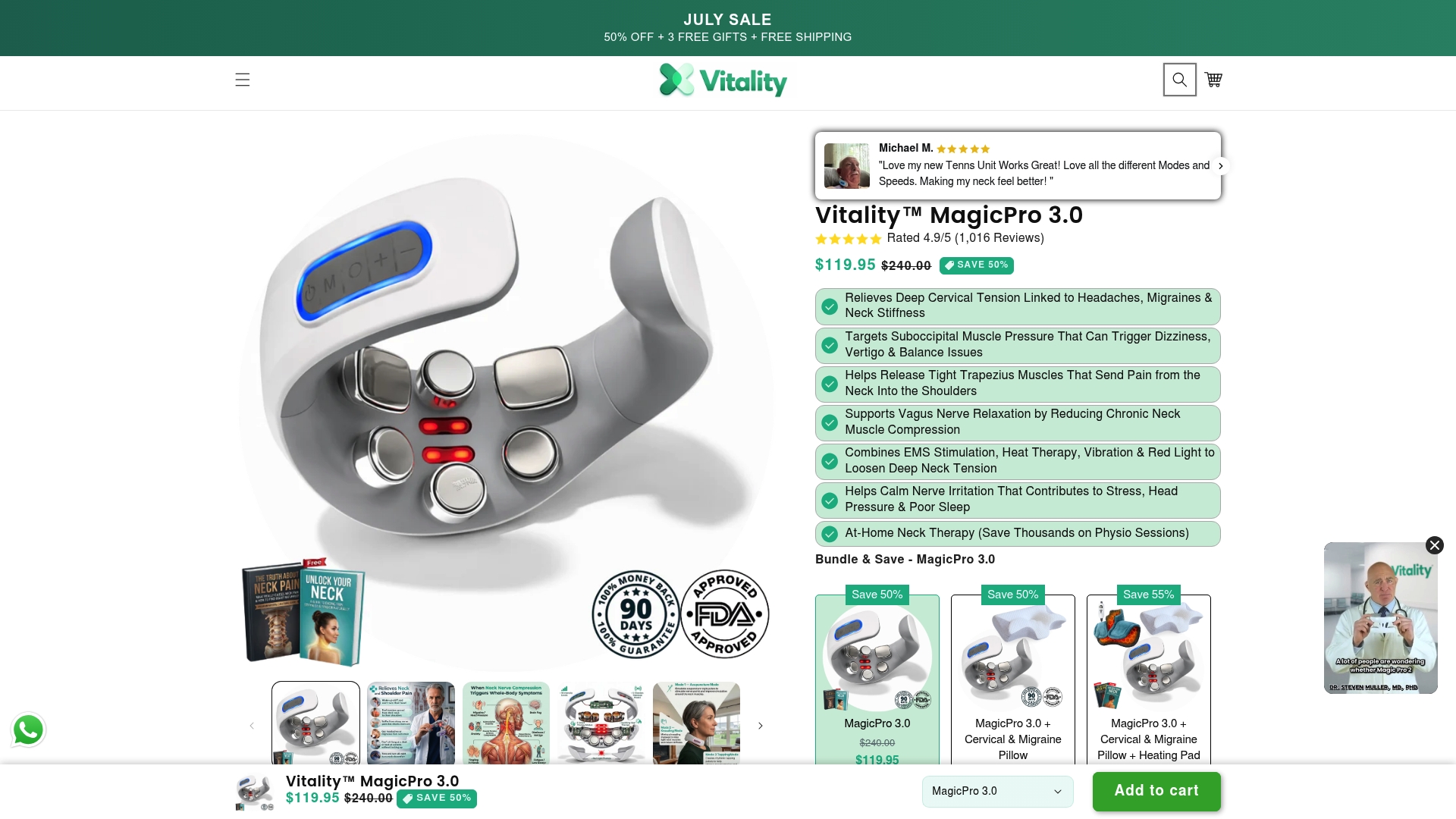
Vitalitytherapy’s MagicPro 2.0 and MagicPro 3.0 devices combine electrical muscle stimulation, heat therapy, and massage in one compact unit. Each 15-minute session targets the cervical muscles directly, restoring circulation and reducing nerve compression that builds up from hours of desk work. Both devices are doctor-recommended and designed for use at home, at your desk, or during a commute. For lower back strain from hyperlordosis or flat back posture, the Vitality™ Cordless Lumbar Massager provides targeted relief without requiring a clinic visit.
FAQ
What are the most common types of office posture problems?
The most common types are forward head posture, rounded shoulders, hyperlordosis, flat back posture, and thoracic kyphosis. Upper Crossed Syndrome, which combines forward head posture and rounded shoulders, affects nearly 90% of office workers studied.
How do I know if my workstation is causing my posture problems?
Check whether your monitor sits at eye level, your elbows rest at 90 degrees, and your lower back has support. Desk setup errors like low monitors and missing lumbar support are the leading environmental cause of office posture problems.
Can posture problems cause headaches?
Forward head posture and rounded shoulders directly cause cervicogenic headaches, which originate at the base of the skull. These are often mistaken for tension headaches but resolve with postural correction rather than pain medication.
Are posture braces effective for office workers?
Passive braces provide short-term relief but can weaken postural muscles over time. Active training devices that use sensor feedback build muscle memory and produce lasting improvement, with 86% of users reporting measurable results within 14 days.
When should I see a professional for posture-related pain?
Seek professional care if you experience numbness or tingling in the arms or hands, pain radiating below the knee, grip weakness, or any symptom that disrupts sleep. These signs indicate nerve involvement and require clinical evaluation.